“One must know the history in order to confront the present and change the future of abuse in the mental health system.”
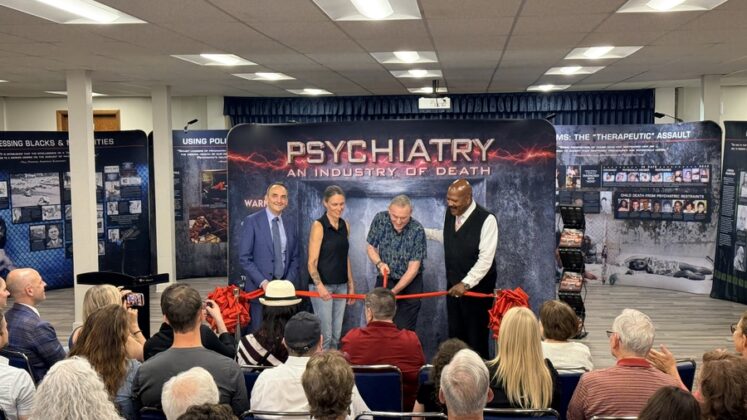
“One must know the history in order to confront the present and change the future of abuse in the mental health system.”
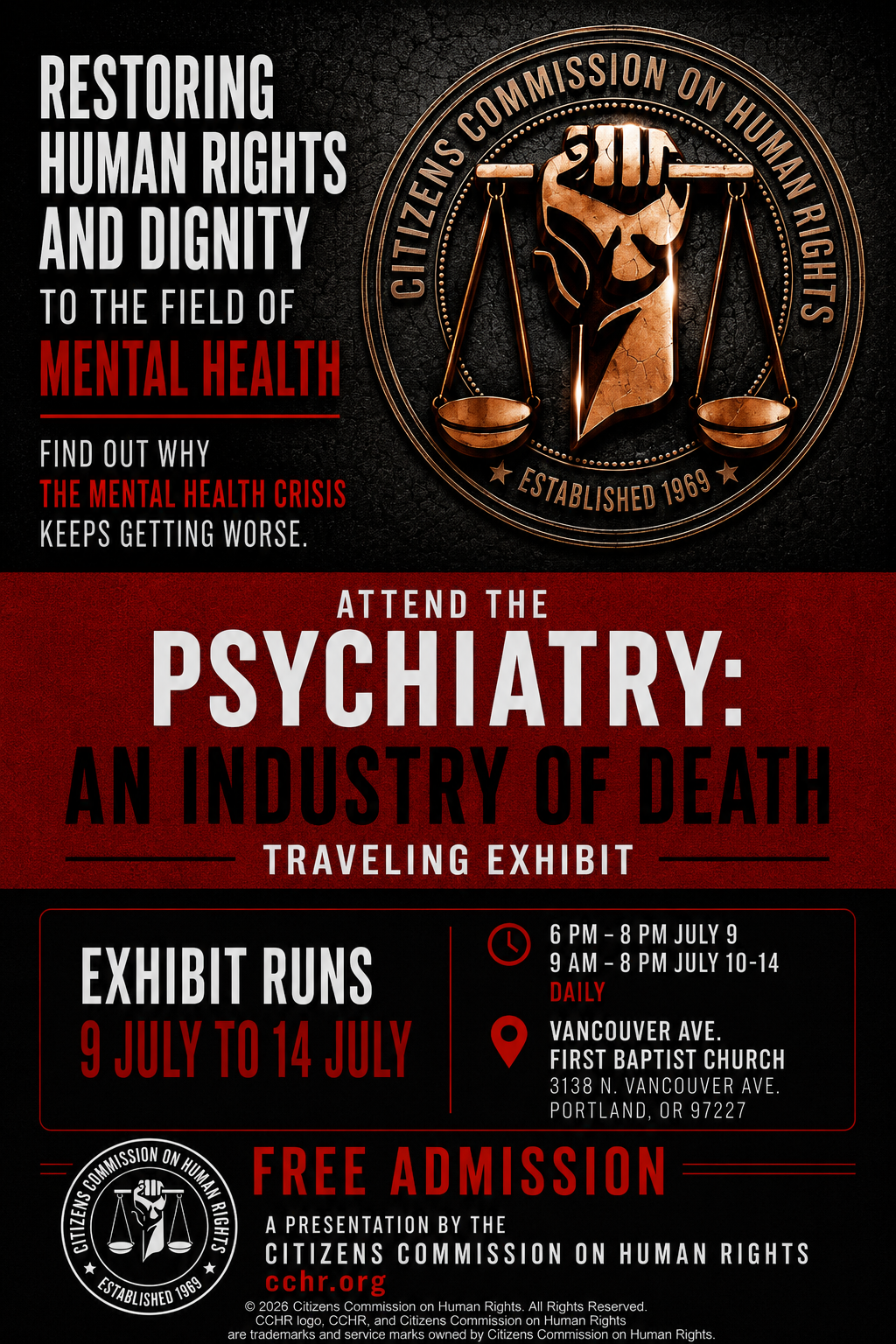
TO THE FIELD OF MENTAL HEALTH
6 PM – 8 PM JULY 9
9 AM – 8 PM JULY 10-14
DAILY
VANCOUVER AVE.
FIRST BAPTIST CHURCH
3138 N. VANCOUVER AVE.
PORTLAND, OR 97227
EXHIBIT RUNS
9 JULY TO 14 JULY
6 PM – 8 PM JULY 9
9 AM – 8 PM JULY 10-14
FREE ADMISSION
A PRESENTATION BY THE CITIZENS COMMISSION ON HUMAN RIGHTS
Original Article: https://www.freedommag.org/news/psychiatric-hospital-whistleblowers-sue-after-patient-dies-in-seclusion-6d0995
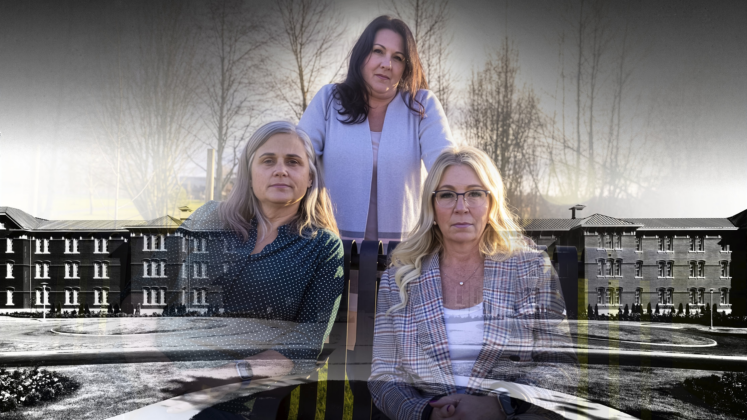
A confidential report described a “culture of complacency” at Oregon’s only public psychiatric hospital. Federal investigators cited leadership failures and an ineffective emergency response in the death of Kenneth Hass.
Sometimes, unexpected heroes emerge—people who put their careers, reputations and families on the line to tell the truth others want buried.
Whistleblowers are among them: men and women with the courage and grit to expose misconduct, protect the vulnerable and force the facts into the open.
And at Oregon State Hospital (OSH)—the state’s only public psychiatric hospital, with campuses in Salem and Junction City—three whistleblowers announced they are suing, alleging they were punished after they spoke out to protect patients’ lives and health.
Their actions came too late to save 25-year-old Kenneth Hass, who had been held for months in a filthy seclusion room after a civil commitment order. He died there on March 18, 2025, after a fatal fall.
“Retaliation is alive and well in this organization.”
Hass was imprisoned and alone—with only a mattress, a urinal and a bedpan in a room strewn with feces. Staff documented him eating food mixed with waste, denied even a fresh meal.
On the night of his death, Hass had been granted access to the seclusion bathroom unsupervised—even though, for months, staffers knew he had tried to jump off the sink and toilet onto the floor.
This time, he did. He leapt from the top of a toilet, struck his head and died. No one came to help him for more than four minutes. By that time, he was long gone.
Nine days earlier, deputy chief nursing officer Lindsey Sande, concerned over Hass’ terrible condition, filed a formal complaint.
“I was aware and had reiterated my concerns about the ongoing seclusion,” she said. “I felt, and my boss felt, that we just were not making any traction on making changes as fast as we felt that we needed to. And I think it came to a point where I felt so helpless that I was willing to take the risk that I knew was probably coming my way to make the formal complaint about his care.”
https://www.scientology.tv/series/cchr-documentaries/psychiatry-an-industry-of-death.html?iframe=1
She said she believed Hass’ death could have been avoided if her complaint had received the proper attention.
Instead a man died, and Sande and two other whistleblowers who raised alarms over patient safety faced retaliatory punishment.
“I took a significant pay cut,” Sande said. Nicole Mobley, another whistleblower and the hospital’s former chief nursing officer, was stripped of her position and pushed out of her job. Katie Iv, the director of nursing excellence, was likewise demoted.
But the women are not backing down, and the hospital now faces at least four additional staff lawsuits alleging retaliation and other charges.
“Retaliation is alive and well in this organization,” Heidi Scott, a program director, said. “If you speak out, or if you rub people the wrong way, something will happen.”
And the whistleblowers weren’t warning about an isolated failure.
A secret 61-page report on the hospital, marked “not for distribution” and obtained by a local publication, found that OSH suffers from a “culture of complacency in which safety issues can be overlooked or ignored.”
Asked for a response, hospital spokesperson Marsha Sills did not address the report’s findings. “Oregon State Hospital (OSH) declines to respond to questions based on an improperly disclosed report,” she wrote.
Between November 2023 and May 2025, five OSH patients died unexpectedly—one after complaining of breathing problems, another on his first day at the facility after no one checked his vital signs, and another from a suspected fentanyl overdose.
Since May 2022, the hospital has also recorded a dozen patient falls resulting in bone fractures or other serious injuries, including intracranial bleeding; four incidents of nonconsensual sexual activity; and three patient-on-patient assaults resulting in serious injury.
The federal Centers for Medicare & Medicaid Services issued a lengthy report on OSH, citing failures in leadership and policy, and warning that the hospital would lose its certification and ability to bill Medicare and Medicaid unless it submitted a correction plan and addressed the deficiencies by August 4, 2025.
Federal findings addressed Hass’ death directly. “The hospital’s medical emergency response to the patient’s loss of consciousness was not timely or effective,” an inspector wrote in a preliminary report.
On April 11, 2025, Dr. Sara Walker, interim superintendent at the hospital, resigned abruptly from her $435,420-a-year job after Governor Tina Kotek’s office learned more about the March 18 death of Kenneth Hass.
At least that’s a start. But it took whistleblowers risking their jobs to force the facts into the open.
When the state locks a patient inside a mental hospital, it assumes a duty to protect his life. In Kenneth Hass’ case, that duty was abandoned—leaving him isolated, degraded and dead on the floor.
What do Munchkin Land and the DSM-5 have in common?
A lot, as you will see.
The fifth edition of the Diagnostic and Statistical Manual is the American Psychiatric Association’s latest attempt to legitimize itself.
At first glance it is most imposing. Each of its 567 mental disorders carries its own code, symptoms and diagnoses galore.
Further, its 947 pages list some 2,000 medicos and 17 prestigious institutions. A scholarly Introduction concludes that their “science of mental disorders continues to evolveâ€.
Surely, the APA is the eminent authority on all things mental.
Then we define science. Merriam-Webster says it’s “knowledge covering general truths or the operation of general laws especially as obtained and tested through the scientific method.â€
Further, Merriam-Webster defines “scientific method†as “the rules and procedures for the pursuit of knowledge involving the finding and stating of a problem, the collection of facts through observation and experiment, and the making and testing of ideas that need to be proven right or wrong.â€
Knowledge comes from the Latin scire, “to knowâ€. As you see, this concrete foundation is composed of words like facts, laws, truth and tested.
Suprise! The word cure is AWOL from every page. The dictionary says it is “a complete or permanent solution or remedy.†Why, then, is it never used in their bible?
Quite simple:
We do not know the causes [of any mental illness]. We don’t have the methods of ‘curing’ these illnesses yet.â€â€”Dr. Rex Cowdry, psychiatrist and former director of National Institute of Mental Health (NIMH)
Apparently they don’t know how it all comes about—and can’t cure it anyway. Given 62 years of DSM history, that sounds more fairy tale than scientific.
Dorothy knows something about surreal. She’s been accosted by Miss Gulch, cursed by a cackling witch and plunked down in a Salvador Dali world. Still, she’s determined to find her way back to Auntie Em and Uncle Henry.
Cut to a huge hall and a towering curtain.
She’s with a scarecrow, a tin woodman—well you know.
A booming voice rumbles around the ominous walls: “Why do you seek my wisdom?â€
The pig-tailed girl, confused and frightened, musters up her courage and inches forward.
Toto’s got his own ideas. He pulls back the screen to reveal a roundish man that looks a lot like Frank Morgan.
(We’ll skip the embarrassment and anger that follows).
Sheepishly, the old man hands Dorothy the DSM-5.
“Maybe this will help.â€
Cracking open the book reveals a sea of troubles: Separation Anxiety Disorder (Page 190), Brief Psychotic Disorder (Page 94), Major Depressive Disorder (Page 160). Or how about Brief Psychotic Disorder (Page 94)?
All in all, 21 possibilities and another 42 “unspecified†disorders as a catchall. That’s 63 different ways to say sadness.
Scarecrow wants a brain? Let’s see… There’s Intellectual Disability Disorder, Somatic Symptom Disorder—
The tin woodman wants a heart? How about Depersonalization Disorder or Somatic Symptom—
–And the mousey lion could have Borderline Personality Disorder or Avoidant Personality Disorder or even Generalized Anxiety Disorder.
Dorothy slams down the book! No help here! Ah, that’s it! This chick has Oppositional Defiant Disorder!
And Dorothy is not the only one up in arms. Since DSM-5 debuted in 2013, it’s been bombarded by those who should be praising it.
Mark Schulman, President of San Francisco’s Saybrook University, said of the book, “There’s this propensity to push pills instead of looking at what’s really going on with the person.”
A Mother Jones article of May 14, 2013 pulled no punches: “Don’t Buy It. Don’t Use It. Don’t Teach It.â€

They interviewed Allen Frances Allen, M.D. (Chair of the DSM-4 Task Force, no less), who protested that the book lumps together the serious conditions with those “that may just be an expectable reaction to everyday life.â€
It’s important that the diagnostic system be taken away from the American Psychiatric Association. It needs to be in safer hands. -Allen Frances MD, Chair of DSM-IV Task Force.
His book, “Saving Normal: An Insider’s Revolt Against Out-of-Control Psychiatric Diagnosis, DSM-5, Big Pharma, and the Medicalization of Ordinary Lifeâ€, says it all.
Then, Thomas Insel, Director of the National Institute of Mental Health, said in his blog of April 29, 2013, that NIMH will be “re-orienting its research away from DSM categories.â€
The book’s “lack of validity†has them concerned. “The DSM diagnoses are based on a consensus about clusters of clinical symptoms, not any objective laboratory measure.â€
“While DSM has been described as a ‘Bible’ for the field, it is, at best, a dictionary, creating a set of labels and defining each.â€
More salvos came from The Society of Humanistic Psychology, who formed the “Coalition for DSM-5 Reformâ€, collecting over 14,000 signatures protesting the book.
If its peers howl at their industry scriptures, it calls into question the validity of psychiatry itself.
As well it should. A practice riddled with uncertainties, no cures and no standards is pure fairy tale.
Listen to your Mother Jones: Don’t buy it. Don’t use it. Don’t Teach it.